
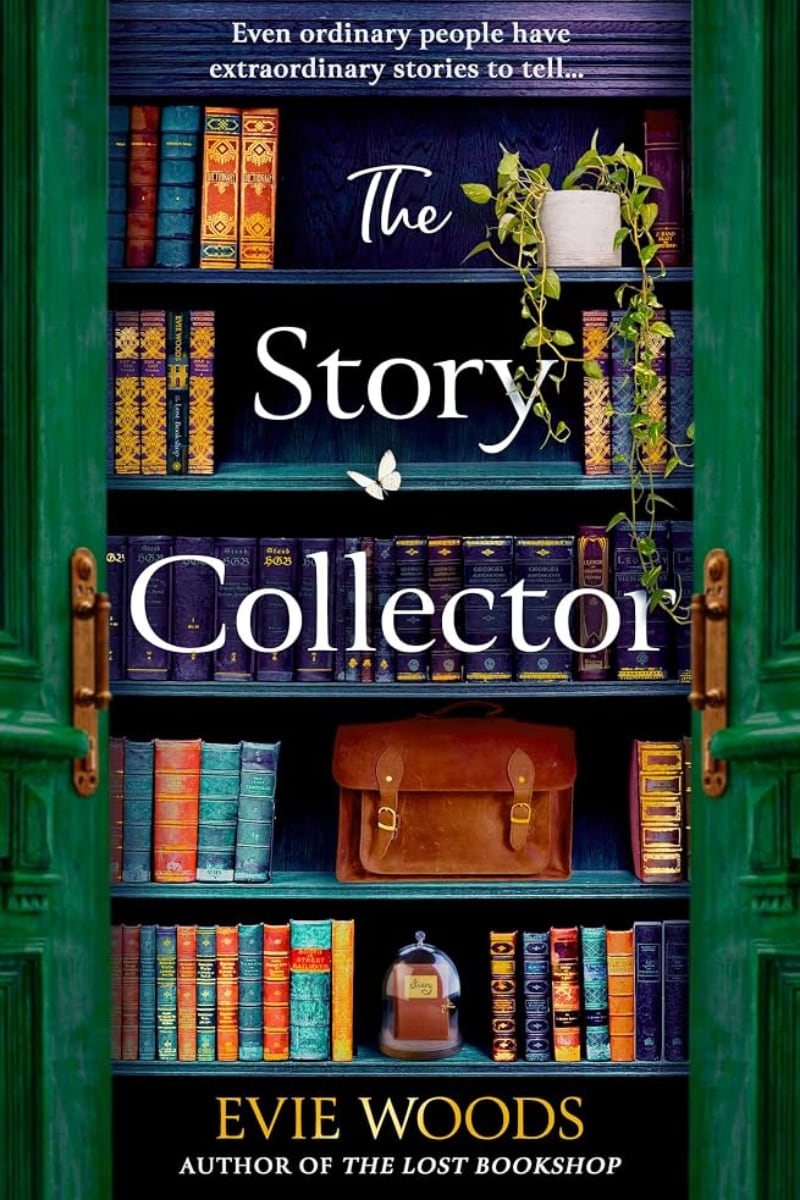
The Story Collector by Evie Woods
One hundred years ago, Anna, a young farm girl, volunteers to help an intriguing American visitor translate fairy stories from Irish to English. But all is not as it seems and Anna soon finds herself at the heart of a mystery that threatens her very way of life.
In New York in the present day, Sarah Harper boards a plane bound for the West Coast of Ireland. But once there, she finds she has unearthed dark secrets – secrets that tread the line between the everyday and the otherworldly, the seen and the unseen.
With a taste for the magical in everyday life, Evie Woods’s latest novel is full of ordinary characters with extraordinary tales to tell.
GUIDE
Themes
two women get wrapped up in tales of the fairies.
Setting
Set in ireland in the modern era and early twentieth century.
Series
NOT PART OF A SERIES.
Review
The Story Collector is the fourth novel from Evie Woods and it is a dual timeline story set in the modern era and the early twentieth century. In 2011 New York, Sarah Harper walks out on her marriage with the intent of heading to Boston to spend Christmas with her sister, however she spots a newspaper article at the airport which tells the story of how a fairy tree was saved by the villagers of Thornwood in Ireland. Finding herself drawn to the story, an intoxicated Sarah buys a ticket to Ireland on a whim and finds herself renting a small remote cottage. While at the cottage, Sarah finds a diary written in 1911 by young woman called Anna Butler.
The chapters alternate between the two women as they both try to navigate the hardships that have been thrown their way. In 1911, Anna unexpectedly becomes an assistant to Harold Griffin-Krauss, an American who is researching Celtic folklore for his thesis. Anna seeks out the older members of the village to narrate their stories to Harold but they soon encounter the Hawley family, Anglo Irish landowners, whose ancestors were apparently cursed by the fairies for cutting down an ancient Hawthorn tree. Anna is vulnerable as she is still mourning the loss of her older sister who she believes is living with the fairies and is instrumental in saving her when Anna is assaulted by the young Hawley heir who is later found dead. The death sets up a series of events which leads to Harold fleeing Ireland and Anna’s diary ending abruptly.
In 2011, Sarah is also vulnerable after the “terrible thing” that led to her marriage falling apart and is later revealed to have been the stillbirth of her daughter. Rather than facing up to her loss, Sarah seeks solace in alcohol and has ultimately run away from her life in the United States. Immersing herself in Anna’s story, Sarah becomes intrigued by the fairy folklore and feels the urge to explore the fairy people through her art. Sarah also has time to fall in love with a hunky forest ranger who used to live in her cottage with his late wife and his teenage daughter.
The novel is a whimsical tale with a scattering of fairy dust over both timelines which are narrated by two very different protagonists even though they have loss in common. I liked Anna a whole lot more than Sarah who continued to seem remote and there is a lot about her that is never resolved. Sarah dulls her pain with alcohol and has a serious problem with it by the time she arrives in Ireland, but it gets swept under the carpet very quickly and barely mentioned again. It is also never really explained why Sarah had such a strong emotional reaction to the story of the tree being saved which brought her to Ireland in the first place. Sarah’s storyline seems to finish at warp speed after she finishes reading the diary and before we know it she is exhibiting her fairy paintings with the help of her ex-husband.
The problem with having Anna’s story told through the point of view of her diary is that her story is told in an unnatural way and not in the way you would expect extracts from a diary as it is more of a narrative than anything else. Anna’s story from her perspective also ends abruptly when the diary is abandoned and Sarah is left to rely on the memories of the villagers to fill in the gaps but that is just unsatisfying. Anna didn’t quite get the happy ending she wanted and she sacrificed her own happiness to care for her family but she did eventually marry. Was she happy with her husband? We’ll never know.
The magical elements of the story are not executed in a satisfying way as they are dropped in haphazardly when the plot needs pushing forward. Who is the old woman Sarah often sees on her walks or in her paintings? Does she really have mice in the loft space or is it something otherworldly? What exactly is in that comforting tea brewed by her neighbour? The villagers in both timelines are a superstitious bunch who fervently believe in the presence of the fairies in their lives but it would have been nice to see a bit more of them.
