
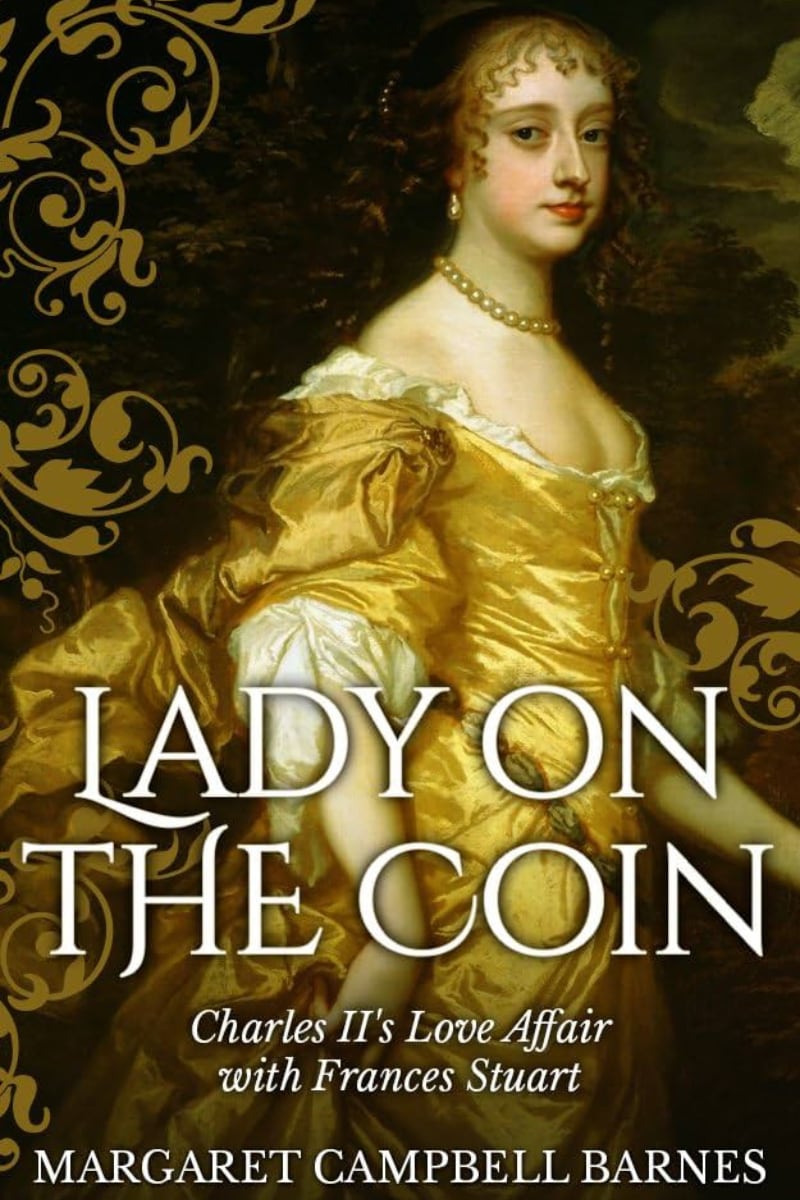
Lady on the Coin by Margaret Campbell Barnes
As a child living in exile in France, Frances Stuart was accustomed to threadbare dresses and going hungry. Yet everything changed when her cousin Charles arrives to visit and Frances’ world is turned upside down.
Several years later, Frances arrives in Court to attend to Charles’ wife, Queen Catherine, as a lady-in-waiting and once again, her path collides with the man who is now King.
At sixteen, she is already renowned for her beauty and vivaciousness and Charles cannot help but take notice of Frances. The King rapidly becomes obsessed with her, and it is not long before whispers begin to circulate that Frances has supplanted the famous Barbara Castlemaine as mistress to the monarch.
GUIDE
Themes
THE BEAUTIFUL FRANCES STUART HAS TO RESIST THE CHARMS OF CHARLES II.
Setting
Set in ENGLAND AND FRANCE IN THE 17TH CENTURY.
Series
not part of a series.
Review
Lady on the Coin follows the life of Frances Stewart, Duchess of Richmond and Lennox, who is famous for refusing to become the mistress of Charles II and serving as the model for Britannia depicted on coinage. Frances was the daughter of Walter Stewart, a court physician and a distant cousin to the royal family, who followed the family into exile. Frances was born in Paris in 1647 and was part of the royal household of Queen Henrietta Maria until she was sent to England as a lady-in-waiting to Catherine of Braganza, the new wife of Charles II who had regained the throne. Frances attracted many suitors at court, but the king fell in love with her and rumours circulated that he intended to cast his wife aside so he could marry Frances. However, Frances evaded his advances and married Charles Stewart, 3rd Duke of Richmond, 6th Duke of Lennox.
The problem with Lady on the Coin is that not much actually happened to Frances Stewart and it is only its rich seventeenth century setting that saves the novel from utter banality. Having said that, much of the historical events, such as The Great Fire of London, are only mentioned very briefly in passing which is a pity. Frances is actually a character who is really hard to like at times as she comes across as being very frivolous in nature and never really loses that when she starts to mature. Having grown up in the toxic court of Louis XIV, you would have expected Frances to be more savvy when it comes to intrigue but her time there is glossed over despite her close companionship with Charles’s sister, Henrietta. There are brief glimpses of how the royal family’s life in France was less than luxurious in comparison to their French counterparts, but there no real examination into its effects on the characters.
Life certainly improves for Frances once she arrives at the court of Charles II and she is soon dubbed La Belle Stuart for her great beauty. Frances innocently flirts with a variety of suitors until the king is attracted by her vivacious nature and Frances soon finds herself at the heart of a plot to oust Catherine of Braganza who has failed to produce an heir. Frances also finds herself being boycotted by Barbara, Lady Castlemaine, as the current royal mistress sees the girl as a rival for the king’s affection. Charles is portrayed as being genuinely in love with Frances but it is hard to swallow considering his womanising reputation and numerous illegitimate offspring which is also downplayed to only those belonging to Barbara. There are hints that Charles is already pursuing the actress Nell Gwyn, whilst professing his love to Frances.
In an attempt to portray a more serious side of Frances, the author details how good she is with managing finances once she marries Lennox to escape the royal court. The romance between her and Lennox is heavily romanticised but she is seen as a steadying force for him as he is a profligate gambler and has heavy debts. Unfortunately, the king sends Lennox as ambassador to the Danish court where he dies in a drowning incident, leaving his wife heartbroken. The last few chapters see Frances back at court where she retains the affection of king but the story just fizzles out. It should be note that Margaret Campbell Barnes died before finishing this novel and it was completed by Hebe Elsna.
More by Margaret Campbell Barnes
No posts