
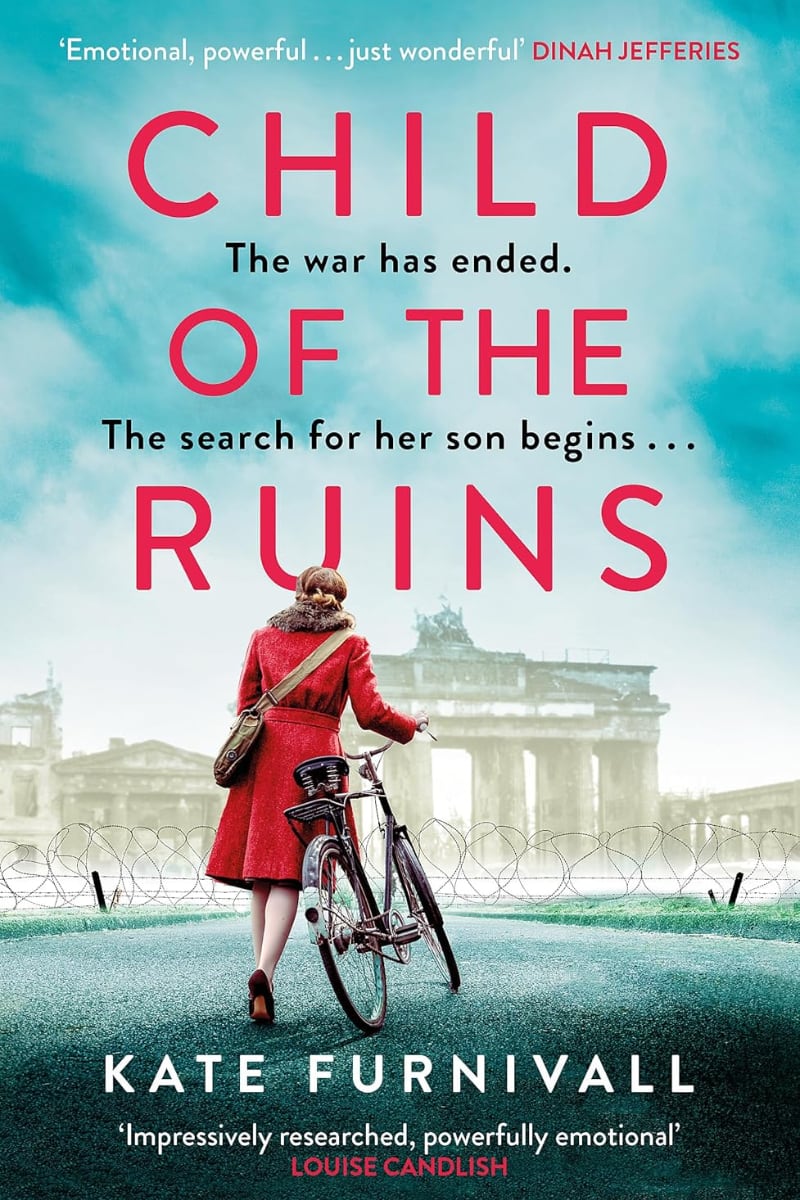
Child of the Ruins by Kate Furnivall
1948, Berlin. World War II has ended and there is supposed to be peace; but Russian troops have closed all access to the city. Roads, railway lines and waterways are blocked and two million people are trapped, relying on airlifts of food, water and medicine to survive. The sharp eyes of the Russian state police watch everything; no one can be trusted.
Anna and Ingrid are both searching for answers – and revenge – in the messy aftermath of war. They understand that survival comes only by knowing what to trade: food; medicine; heirlooms; secrets. Both are living in the shadows of a city where the line between right and wrong has become dangerously blurred.
GUIDE
THEMES
A woman hunts for a missing child in the city ruins.
SETTING
Set in Berlin, Germany, in the 1940s
SERIES
Not part of a series.
Review
Child of Ruins is set in Berlin three years after the end of the Second World War where the city is still divided into segments controlled by the Allied Forces. After an uneasy alliance over the past three years, the Soviets now want the whole the city so they have introduced a blockade to prevent basic supplies from flowing into the sectors. In response, the Allies organised the Berlin Airlift to fly supplies into the city which was highly dangerous as the Soviets did everything they could to sabotage the landings. Despite this, the Berliners still found themselves in dire straits as both fuel and food were scarce. Berlin was severely bombed by the Allies during the Second World War so most of the city is still lying in ruins.
Agains this backdrop, Anna Wolff is desperately hunting for her child, Felix, who was taken away from her by her mother, Luisa, when she was delirious with a fever. Felix was conceived as a result of a rape by Soviet soldiers so Luisa cannot bear to have him in the house as he is a constant reminder of that dark day. However, Anna never blamed the child and is desperate to find him even though he has been gone for three years. To help pay for the detective who is conducting the search, Anna gets a job at Tempelfot Airport in the western sector of Berlin where the planes loaded with supplies fly in on a regular basis. When she goes for her interview she narrowly misses being killed in an explosion near the base that is believed to have been caused by the Soviets, however further incidents lead Anna to believe that she is the one being targeted.
Our second protagonist is Ingrid Keller, a former circus performer, who gets a job working on a mobile catering unit at Tempelfot Airport so she can pass information about the Americans to a Russian spy who is also looking for information on Anna. Although Ingrid’s motivation is to get enough money to start up the circus once more, she has no idea how dangerous the Russian spy is and it is not long before she is in over her head. Before long, Ingrid’s path crosses with Anna’s and the two women must fight for survival.
While both Anna and Ingrid are interesting characters, I could not really get invested in either of their stories. There were a lot of twists and turns but it was ultimately unsatisfactory. The other narrator is Anna’s Russian lover, Timur Voronin, who comes back to Berlin after a three year absence and is hoping to renew his romance with Anna. However, Anna is not the same girl he left behind as three years of battling to survive and the loss of her child have changed her. While Voronin is not the father of her child, Anna is angry with him for abandoning her, not realising that her mother has hidden his letters and gifts, and wants nothing to do with him. I’m not really sure Voronin’s narration added anything to the story though.
However, the really impressive part of the story is the author’s description of the ruined city and the horrible living conditions the Berliners are having to endure even three years after the war. Although the Allies have pledged to invest in the city to help rebuild it, many of the buildings are still lying in piles of rubble. The Soviets are also intent on stripping the eastern part of everything and their unexpected raids strike fear into the hears of the citizens, as do the increasing number of disappearances. Furnivall has obviously done a massive amount of research into Berlin and the descriptions are so vivid it is not hard to imagine it. The thought of all those poor orphaned children having to fight for survival alone is also heart wrenching.


