
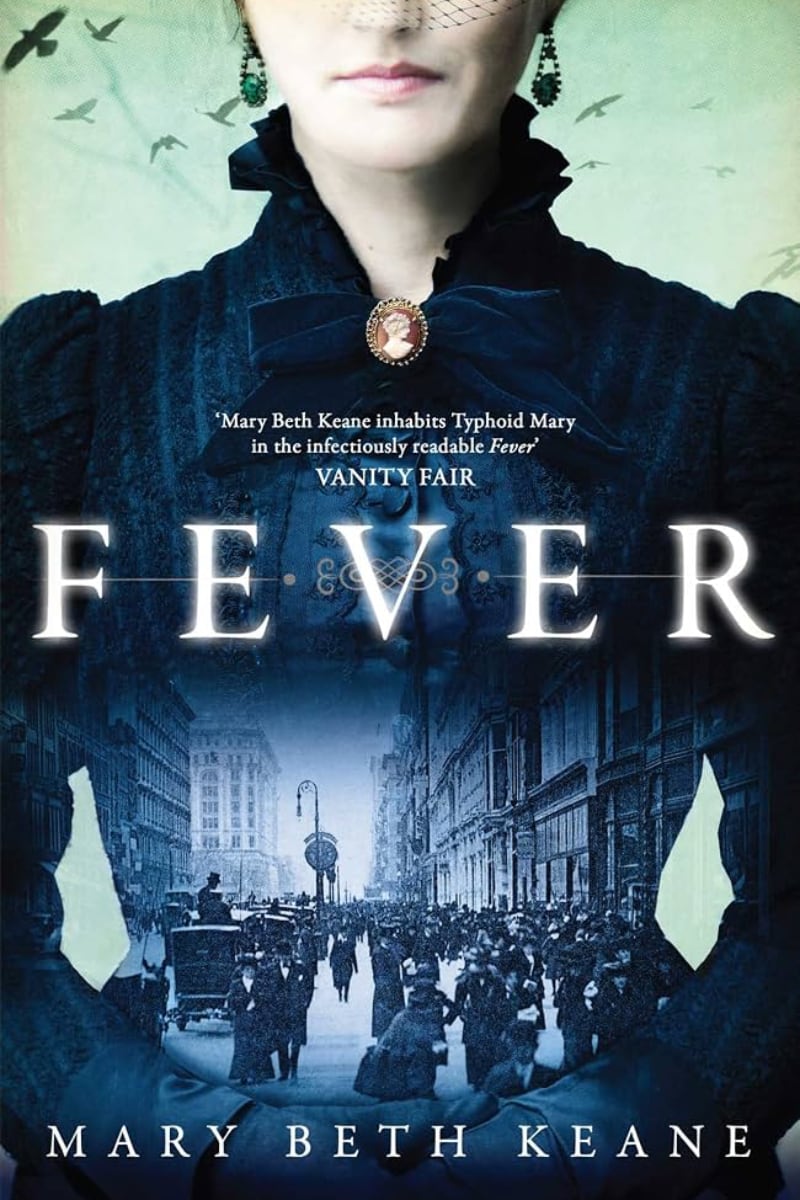
Fever by Mary Beth Keane
Mary Mallon was a courageous, headstrong Irish immigrant woman who bravely came to America alone, fought hard to climb up from the lowest rung of the domestic service ladder, and discovered in herself an uncanny, and coveted, talent for cooking.
Working in the kitchens of the upper class, she left a trail of disease in her wake, until one enterprising and ruthless doctor proposed the inconceivable notion of the “asymptomatic carrier”. In order to keep New York’s citizens safe from Mallon, the Department of Health sent her to North Brother Island where she was kept in isolation from 1907-1910.
She was released under the condition that she never work as a cook again. Yet for Mary—spoiled by her status and income and genuinely passionate about cooking—most domestic and factory jobs were heinous.
GUIDE
Themes
THE true story of the woman who would be known as typhoid mary.
Setting
Set in new york in the late 19th and early 20th century.
Series
not part of a series.
Review
Most people are familiar with the phrase Typhoid Mary and how it has become a colloquial term for anyone who spreads disease, yet there are many who don’t know the story of Mary Mallon and how she inherited the unflattering nickname. Born in County Tyrone, Mary emigrated to the United States when she was fifteen and she eventually gained a favourable reputation as a cook for wealthy New York families. However, Mary was unaware that she was an asymptomatic carrier of typhoid fever and she was unwittingly spreading the disease amongst the families and their guests. Typhoid, an orally contracted disease, is spread by ingesting food or water contaminated with the faeces of an infected person. It was George Soper, a sanitation engineer and epidemiologist, who traced the source of the infection back to Mary and had her taken into custody.
As the story begins, forty-year old Mary is living in a cottage on North Brother Island where she has been quarantined by the health board until the outcome of her trial. Mary reminisces about her emigration to the United States and her desire to build a better life for herself using her cooking talents. However, being an Irish immigrant isn’t easy in New York and she faces a lot of prejudice before is she able to prove herself as a more than adequate cook. Mary talks about the families she worked for but it takes a while for her to mention about how people would suddenly get sick around her and how she would help nurse them back to health. Of course, the reader is all too aware of what is happening but Mary is ignorant of the facts at that stage so she has no inkling that she is responsible.
There is one particular child whose death haunts Mary throughout the novel which is supposed to engender a measure of sympathy for her but it ultimately fails because she refuses to believe she is making people sick. When Mary is eventually released from North Brother Island, it is on the understanding that she stops working as a cook and reports to the health department every three months for testing. However, it isn’t long before Mary takes a job as a cook in a maternity hospital under an assumed name leading to an outbreak of typhoid which kills two people. The author tries hard to persuade us that Mary is just a victim of circumstances here by painting Soper as the villain who keeps appearing out of the blue to ruin everything for Mary. However, Soper is the expert and it would have been a better balance to hear his side of things rather than Alfred Briehof, the man who was living with Mary, who contributes nothing to the story other than a means to pad it out.
The author does do a good job of creating the atmosphere of New York in the twentieth century, particularly the poverty in the tenements and the lack of sanitation which is quite topical considering the main theme of the book. There is no doubt that Mary Mallon faced a lot of prejudice in her life being a poor Irish immigrant and a single woman, however I would have expected more focus on the stigma she faced after making the headlines. Mary was not the only asymptomatic carrier identified but she was definitely the worst treated. When she is returned to quarantine on the island, Mary’s story rather fizzles out and we jump ahead to an ailing woman who is nearing the end of her life. Sadly, there really wasn’t much in Mary’s life to warrant a novel if the focus was going to be away from the disease side of things.
More by Mary Beth Keane
No posts