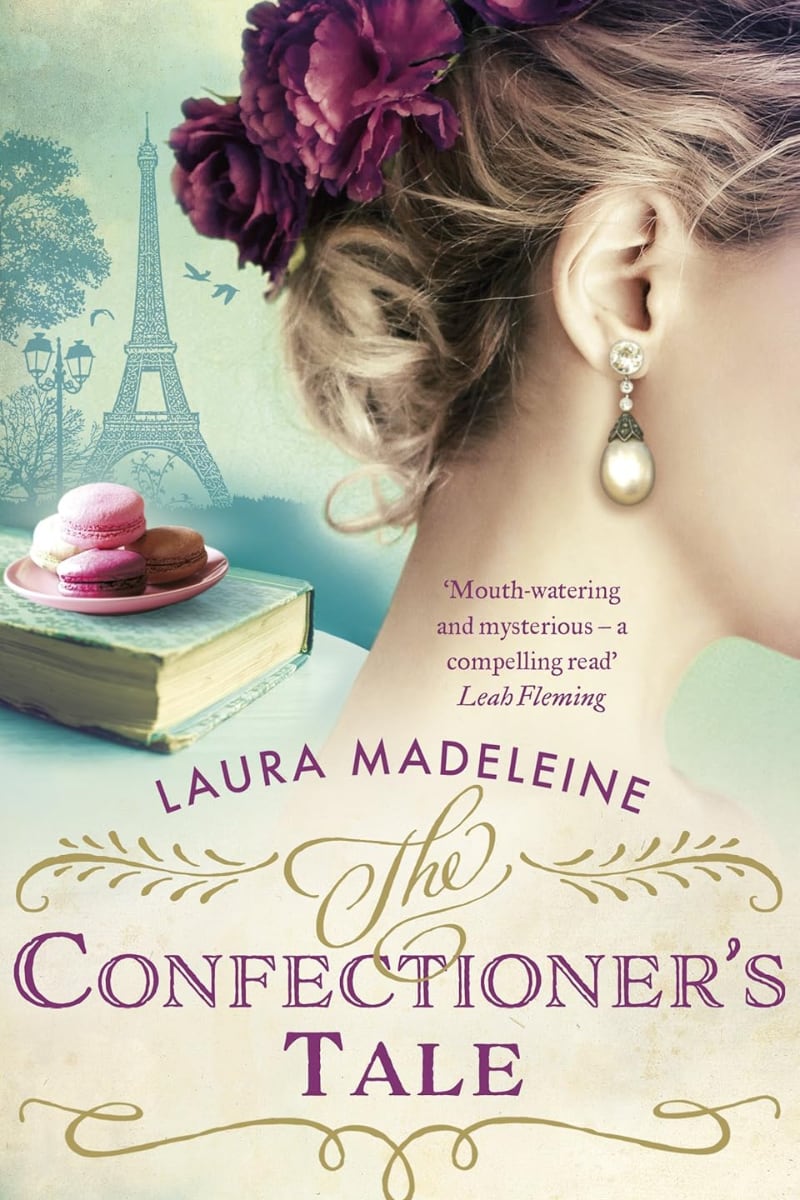
The Confectioner’s Tale by Laura Madeleine
At the famous Patisserie Clermont in Paris, 1909, a chance encounter with the owner’s daughter has given one young man a glimpse into a life he never knew existed: of sweet cream and melted chocolate, golden caramel and powdered sugar, of pastry light as air.
But it is not just the art of confectionery that holds him captive, and soon a forbidden love affair begins.
Almost eighty years later, an academic discovers a hidden photograph of her grandfather as a young man with two people she has never seen before. Scrawled on the back of the picture are the words ‘Forgive me’. Unable to resist the mystery behind it, she begins to unravel the story of two star-crossed lovers and one irrevocable betrayal.
GUIDE
THEMES
A bittersweet love story that echoes through the decades.
SETTING
Set in Paris, France, at the start of the twentieth century.
SERIES
Not part of a series.
Review
The Confectioner’s Tale has two narratives which are marked by two different tenses, Petra in the present and Gui in the past. While both narratives blend well together, Petra’s story in the present suffers in comparison to that of Gui because her exploits are just not as interesting and don’t hold up well against the descriptions of 1910s Paris. Petra is a student at the University of Cambridge who is struggling with her final dissertation after the death of her beloved grandfather and when she learns his biographer has uncovered a dark secret that may tarnish his reputation, she is determined to stop him. Unfortunately, the ultimate revelation is really disappointing, although I’m not going to reveal it, suffice to say it proves to be far too weak for the resulting chaos.
The real strengths of the novel lie in the wonderful descriptions of Paris in la belle époque and the author does an excellent job of capturing the feel of the era which overshadows the rather drab 1980s as a result. I loved the time spent in the patisserie and would’ve been more than happy staying within its walls for the entire novel as you could almost smell and taste the delightful creations. The love affair between Gui and Jeanne is less satisfying as it is quite passionless, however it is very sweet and I did like them both. Jeanne is a woman ahead of her time, trying to escape the restrictions placed on her by society and this is nicely reflected in Petra’s story as she also seems trapped within the expectations of other people.
The whole story is as deliciously light and fluffy as some of the confections made, and while I would’ve liked more focus on the patisserie, it is an enjoyable and easy read. The cover is also beautiful.